

 REQUEST INVITE
-2.png)
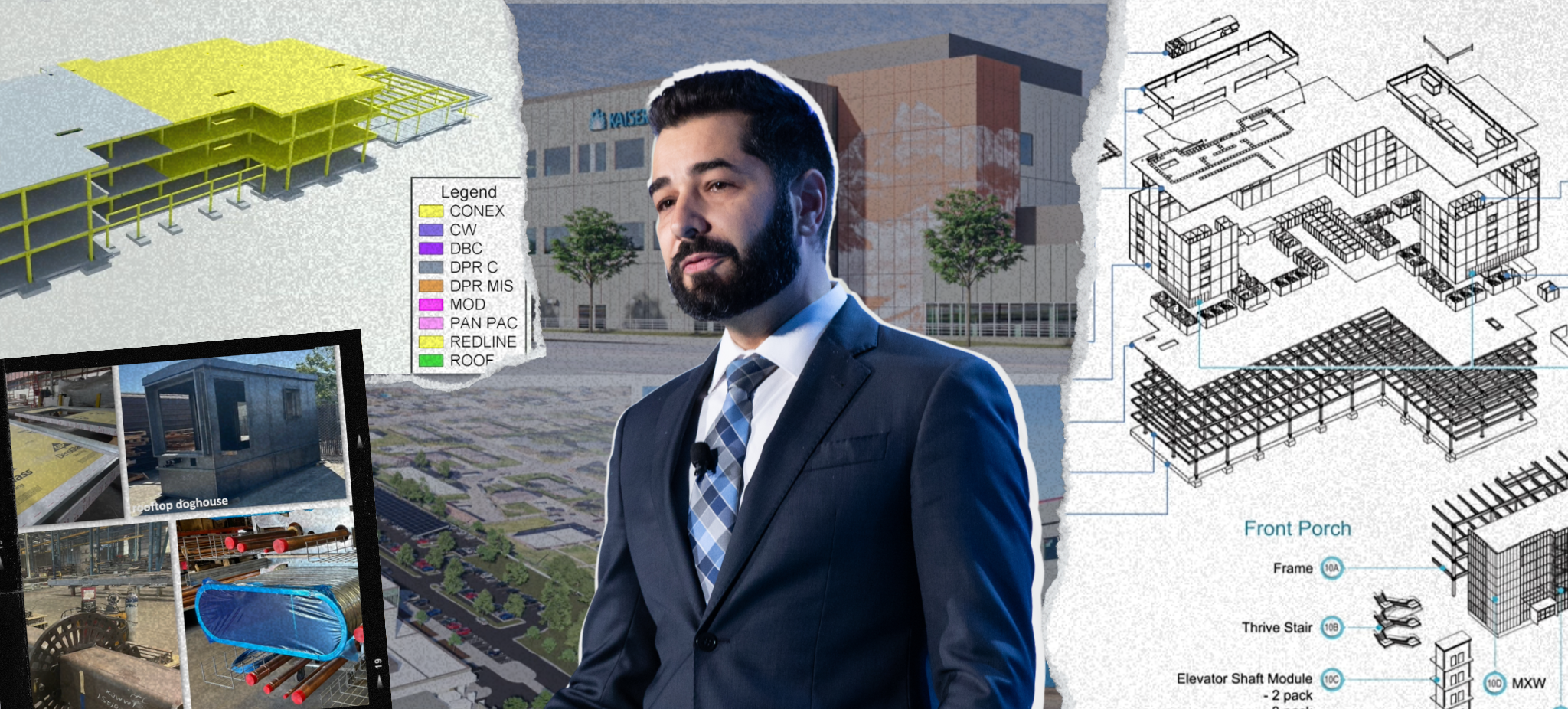
Modular construction doesn't look the same everywhere. At HCA Healthcare, Rob Crotty, AVP of Capital Productivity Improvement and Strategy, is pushing prefab into the toughest environments: hospital additions and freestanding ERs. At Kaiser Permanente, Sunil Shah, VP of Facilities Planning and Design, has spent a decade turning outpatient medical offices into a repeatable product.
Apples and oranges? Definitely. But both leaders admitted they've wrestled with prefab's messy middle—and both came away with lessons that can help any health system move beyond pilot projects.
Their detailed stories are covered in our individual pieces on HCA's journey and Kaiser's transformation. Here's what their contrasting approaches reveal about making modular stick.
HCA: Trial, Error, and a Turning Point
Crotty's path has been trial and error in acute-care settings. His $1.5 million prefab kit that somehow turned a $5 million project into $6.5 million taught HCA a crucial lesson: "Nobody changed how they did their pre-construction work, the pricing, because they really didn't know what this thing was."
The breakthrough came from reframing value measurement. HCA's refined modular approach now delivers freestanding ERs in seven and a half months versus 11 months for stick-built. Those five extra months of revenue more than compensate for any construction premium.
The key insight: coordinate prefab components during design, not after construction documents are complete.
Kaiser: Building a System, Not Just a Project
While HCA was wrestling with hospital complexity, Kaiser was taking a different approach—starting with outpatient facilities where repeatability is possible.
Shah started with clinical operations, getting 2,500 clinicians to agree on standardized care delivery. "If you can't get your clinical colleagues to agree on one way to operate, it's very difficult to build buildings with lots of variations and reduce cost," he explained.
That foundation enabled Kaiser's comprehensive approach: 220 standardized room templates, digital building components, and a platform that can program a building "within hours" compared to the previous 12-18 month process. Their Lakewood project is tracking toward 24% time reduction and 20% cost savings, with 75% of the building prefabricated.
Lessons for Other Health Systems
Despite tackling different facility types, Crotty and Shah echoed each other on what it really takes to make modular programs stick:
Systematic change beats one-off projects. Both emphasized that individual pilots rarely deliver promised economics. Success requires changing workflows, not just materials. As Crotty put it: "Usefulness scored high, but ease of use scored low."
Schedule acceleration matters most. Whether it's HCA's construction time savings or Kaiser's design process improvement, both focus on speed to market as the primary value driver.
Realistic expectations are crucial. HCA reports consistent 5–7% cost savings. Kaiser’s platform-based model is delivering closer to 20%. Both are below the 30% often touted by prefab evangelists—but far above what most systems achieve today.
When Each Approach Makes Sense
HCA's iterative approach works for health systems doing primarily renovations and expansions, where existing constraints limit standardization. Kaiser's platform strategy requires primarily new construction with sufficient volume to justify upfront investment.
Both required a decade of sustained effort. Both needed leadership commitment that outlasted typical strategic planning cycles.
The Long Game
The settings may be different—messy hospital additions at HCA, standardized medical office buildings at Kaiser—but the message was the same: modular construction isn't a shortcut. It's a long game. And for leaders willing to rethink how their organizations design, plan, and measure value, it's starting to pay off.
Watch the full talk below...

Posted by
Collaborate with your Peers!
HealthSpaces is a community for people that plan, design, build and operate spaces where healthcare is delivered.
May 16-18, 2027 | Broomfield, CO
Learn More
-2.png)
.png)
-Mar-03-2026-04-36-47-9807-PM.png)



Comments