

 REQUEST INVITE
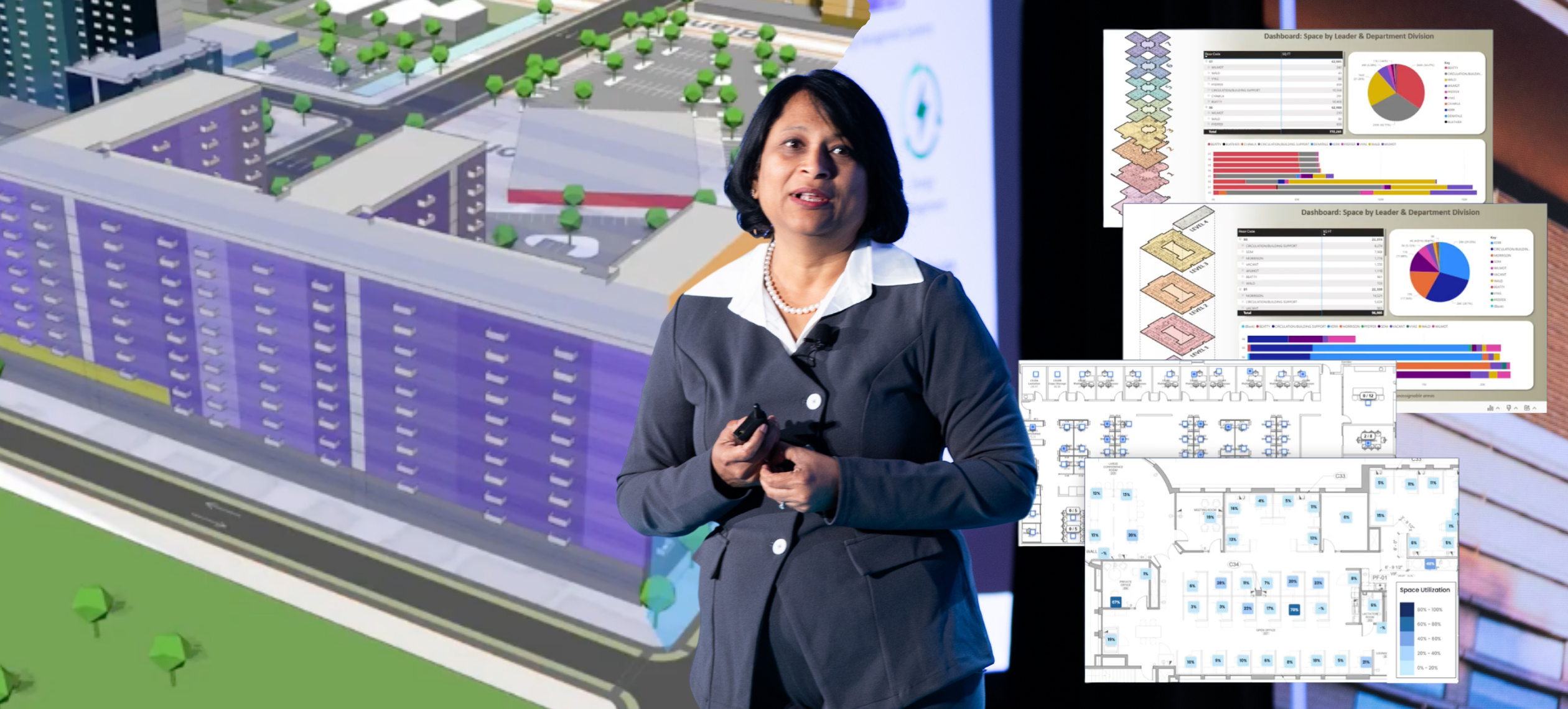
Priya Cherukuru has interviewed more than 20 architecture and engineering firms. Her observation: "The firms that thoughtfully incorporate AI into their work stand out."
That interest is turning into expectations. Stanford Health Care is exploring how AI capabilities can become part of its A&E partnerships, with firms encouraged to demonstrate how emerging technologies can improve efficiency, design quality, and project delivery.
At HealthSpaces, Cherukuru, Vice President of Facilities Planning & Design at Stanford Health Care, shared how her team is beginning to bring AI into the everyday work of planning, design, construction, and operations.
She was also clear about where Stanford is in the journey. "We don't claim to have all the answers yet, but we're learning, experimenting, and building the future alongside our partners."
The scale that drives it
Stanford Health Care's Facilities Services organization oversees a large capital portfolio and strategic investments advancing over the next decade, that includes the Redwood City Cancer Center, a new medical office building and lab facilities, and ambulatory care investments, continued growth in Tri-Valley, and infrastructure upgrades to meet California's seismic requirements.
The scale is significant. So is the complexity. "As the Facilities Planning and Design team, we need to know everything about our buildings and its data as our everyday reality," Cherukuru said.
Bringing it under one umbrella
Facing financial headwinds for our capital investments and aiming for greater efficiency, Stanford Health Care brought Facilities Operations, General Services, and Planning, Design and Construction together under one umbrella: Facilities Services: Planning for tomorrow, managing for today.
Start with better data
One of Stanford's earliest AI initiatives focused on occupancy sensing, a journey that began on the HealthSpaces stage. Cherukuru first shared the sensor pilot at HealthSpaces 2024. Two years later, Stanford Health Care is expanding the program across clinical and administrative work environments to help optimize existing spaces and improve utilization.
"Data and space management is no longer a choice. It's a foundational capability," she said.
The sensors provide daily and weekly utilization insights that inform planning and design decisions. Instead of relying on assumptions or anecdotal feedback, teams bring objective data into conversations about workplace strategy, space allocation, and future investment.
"Data allows us to have more productive conversations and make better-informed decisions."
Put AI into the work people already do
Stanford Health Care approaches AI through three lenses: personal productivity, business processes, and operational transformation. The goal is not to deploy AI for its own sake. It is to embed AI into the everyday work already being performed.
As teams across Facilities Services began identifying where AI could help their work, 162 potential use cases surfaced.
162 ideas still require choices
Once those ideas were on the table, Stanford needed a way to decide what was worth pursuing. The organization created a governance process that includes screening, IT involvement, and a funding mechanism for determining which AI projects move forward.
Cherukuru described the framework simply: a clear vision and plan, the money to do what's right, with clear decision-making with AI as a tool and cost reduction strategy.

Posted by
Collaborate with your Peers!
HealthSpaces is a community for people that plan, design, build and operate spaces where healthcare is delivered.
May 16-18, 2027 | Broomfield, CO
Learn More
-2.png)
.png)
-Mar-03-2026-04-36-47-9807-PM.png)



Comments